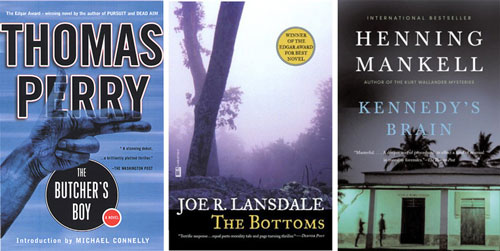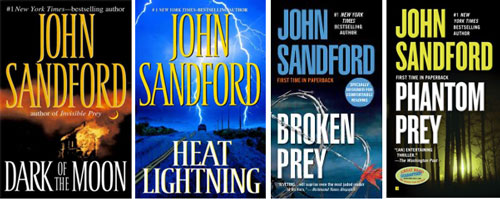
I started the year reading four John Sandford novels. Back to back, to back, to back. (Do I need another “to back”? Not sure.)
First came “Dark of the Moon,” Sandford’s first novel starring investigator Virgil Flowers. I found Flowers to be quite an engaging character, even more interesting that the renowned Lucas Davenport from Sandford’s “Prey” series. Flowers actually works for Davenport out of Minneapolis, Minn., and he regularly checks in with Davenport.
I liked “Dark of the Moon” so much–and Flowers so much–that I read the second Flowers book, “Heat Lightning.” It, too, was a winner. And I realized I had drawn a very good mental picture of Flowers:
- Tall, lanky.
- Shoulder-length blonde hair.
- Always wears a T-shirt from a rock group (some well-known, like Sheryl Crow or AC/DC, others obscure groups), accompanied by a blazer and cowboy boots.
- He’s a preacher’s kid, who thinks about God a lot, but doesn’t actively practice any religion.
- He’s been married three times.
I realized that, though I’d read at least 15 of the Lucas Davenport novels (out of 19 to date), I didn’t have a clear picture of Davenport. So after reading those two Virgil Flowers books, I thought I should read about Davenport again. As it turns out, I had two on my shelf: “Broken Prey” and “Phantom Prey,” awaiting my attention.
But after reading them, I still don’t have a clear picture of Davenport in my head.
However, all four of these were excellent books, each dealing with a serial killer. Sandford is a master at misdirection, dropping all kinds of clues but still keeping the reader in the dark. He plays fair. Raymond Chandler and Dashell Hammet would wait until the end, when the protagonist would deliver a long speech explaining everything that had happened, including information not previously available to the reader. I don’t like that. With Sandford, the mystery gradually unfolds, and you’re aware of what’s happening as the hero is.
In most books, you don’t know the killer until toward the end. In others, like “Invisible Prey,” you know who they are all along; you’re just waiting for Davenport to figure it out. Then there are books like “Phantom Prey,” where the reader finds out about halfway through (though in that case, plenty of mystery remained). Sandford always does it right.
In brief:
- “Dark of the Moon” occurs in a small town, with the requisite small-town intrigue where everybody knows everybody else.
- “Heat Lighting” involves a group of men who were in Vietnam together, and are getting killed one after another.
- “Broken Prey” involves murders with a connection to a prison hospital. One of his better “Prey” books.
- “Phantom Prey” involves killings in the Goth community. Has some psychological thriller elements, and I’m not a real fan of that.

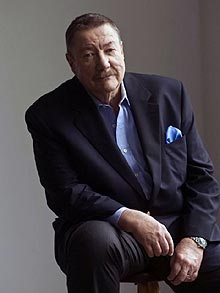 Robert Parker, one of my favorite writers, died on Monday. He wrote 37 Spenser mysteries, short books that take practically no time to read. He also kept three other series going–Jesse Stone, Sunny Randall, and a western series (from which the movie “Appaloosa” came).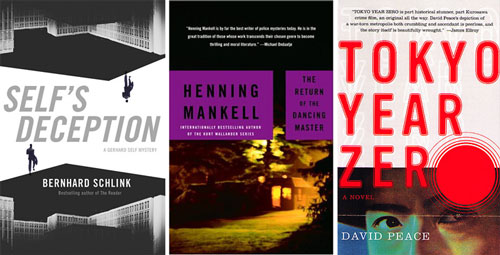
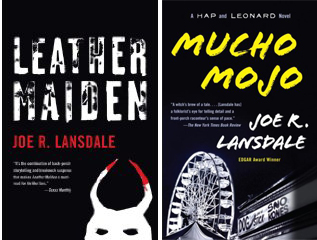 I’ve now read four books by Joe Lansdale, and I must say, he’s becoming one of my favorite authors.
 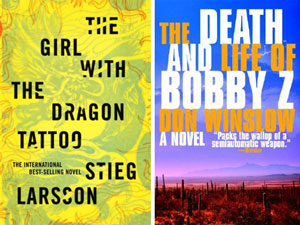 I just finished two more books from the Vantage “Black Lizard” imprint.
 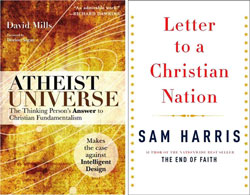 Surveys show that atheism and agnosticism are on the rise in the United States. Christianity is ascendant in other parts of the world, particularly Latin America and Africa, but not in Western countries. I don’t know why. But I decided to try to understand better how atheists see the world and view Christianity.
 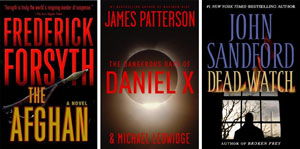 I’m a little behind on reviewing books I’ve read. Here are three recent novels.
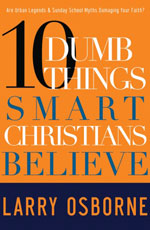 I just finished Larry Osborne’s book, “10 Dumb Things Smart Christians Believe.” This is a follow-up to his book “Spirituality for the Rest of Us” (which I read under the title “A Contrarian’s Guide to Knowing God”). “Spirituality for the Rest of Us” was better, but this sequel is well worth the cost. Anything to make you think about what you believe.